
For a local business owner, that raises an obvious question: If AI platforms are deciding who to recommend in your area, what determines whether your business shows up?
That's what GEO is designed to address. If your Local SEO is already in decent shape, you're closer to being ready for it than you might think.
More...
So, What Is GEO?
GEO stands for Generative Engine Optimization. It's an industry term used to describe improving visibility within AI-generated answers and recommendations.
It's the practice of ensuring your business shows up when AI platforms like ChatGPT and Gemini generate answers to the questions your customers are asking. You'll also see it called AEO (Answer Engine Optimization) or AIO (AI Optimization).
All of them mean essentially the same thing.
GEO, as we’ll call it for the sake of this article, is about making sure your business is one of the ones being included in that AI answer.
The good news is that many of the signals AI platforms appear to rely on overlap heavily with the factors that have historically supported strong Local SEO. More on that below.
Why This Matters for Your Local Business
Web traffic from AI-driven referrals increased more than tenfold in the United States between July 2024 and February 2025. The shift is showing up across business types, though it plays out differently depending on what you do:
- Home services (plumbers, HVAC, electricians, roofers): Customers in research mode are asking AI who the trusted local options are instead of scrolling through search results.
- Automotive (dealerships, service departments): Car buyers are increasingly using AI to research dealerships, vehicle options, and local buying decisions before visiting a dealership.
- Healthcare and dental (dentists, chiropractors, med spas): Patients asking which practices are taking new patients or who specialize in what they need.
- Legal (personal injury, family law, criminal defense): People researching local firms and legal options before contacting an attorney.
- Senior living and care: Families using AI to narrow down options for a parent rather than browsing through a dozen websites.
In every one of those situations, someone wants to know who to contact, and they’re generally asking informational questions as well. The businesses that come up are more likely to earn consideration, website visits, and ultimately calls from potential customers.
The Good News: Your Local SEO Is Already Working For You
Here's something that doesn't get said clearly enough. The businesses showing up in AI-generated answers aren't there because they discovered some new tactic. They're there because they have their basics in order.
In many cases, they're also businesses that have built a recognizable presence beyond their own website. They're mentioned in industry publications, featured in local media, active in professional organizations, and consistently referenced across the web.
They also most likely have done things like:
- Maintaining an accurate Google Business Profile with strong, recent reviews
- Ensure consistent business information across every directory and listing on the web
- Have clear content on their website about what they do and where they do it
How to Improve AI Visibility
While no business can guarantee inclusion in AI-generated answers, there are several best practices that may improve your visibility across AI-powered search experiences.
Answer Questions Directly
AI platforms frequently surface content that clearly and directly answers a user's question. When creating content, avoid forcing users to scroll through multiple paragraphs to find the answer. Instead, provide a concise answer immediately below the heading, then expand on the topic with supporting details.
For example:
How much does HVAC repair cost? HVAC repair costs typically range from $150 to $1,500, depending on the issue, location, and equipment involved.
Then provide additional context, examples, pricing factors, and recommendations below. This answer-first approach makes it easier for both users and AI platforms to identify and reference key information.
Create Original Insights and Data
One of the strongest ways to stand out is to publish information that doesn't exist anywhere else.
Examples include:
- Industry studies
- Original research
- Survey results
- Customer data
- Benchmarks
- Case studies
- First-hand observations
AI platforms have little reason to cite generic information that appears on hundreds of websites. Original insights give them a reason to reference your website specifically.
Demonstrate Real Expertise
AI platforms are designed to surface information they consider trustworthy. Sharing first-hand experience, expert insights, case studies, and educational content can help establish credibility for both users and AI systems.
For local businesses, expertise often comes from demonstrating real-world experience of serving customers rather than simply publishing more content.
Build Your Brand Beyond Your Website
AI platforms increasingly evaluate businesses as entities, not just websites. They look for signals that help confirm your business is legitimate, trusted, and recognized within your market.
Look for opportunities to build local visibility through:
- Local news coverage
- Industry publications
- Chamber of Commerce listings
- Podcasts
- Conference speaking engagements
- Professional organizations
- Trusted business directories
- Online communities and forums
The more consistently your business is referenced across trusted sources, the easier it becomes for AI platforms to understand who you are and what you do.
Maintain an Accurate Google Business Profile
Your business hours, services, categories, photos, and reviews help search engines and AI platforms understand your business.
For local businesses, your Google Business Profile remains one of the most important sources of business information available online.
Keep Your Business Information Consistent
Make sure your name, address, phone number, website, and service information are accurate and consistent across directories, review sites, and local listings.
Consistency helps search engines, AI platforms, and potential customers validate information about your business.
Earn and Respond to Reviews
Reviews help establish trust and provide additional context about your business, services, and customer experience.
Strong review profiles can reinforce the reputation signals AI platforms may use when evaluating local businesses.
Keep Your Website Updated
Outdated information creates confusion for both customers and AI platforms.
Regularly review your services, locations, contact information, and content to ensure everything remains accurate and current.
Focus on Trust, Not Tricks
GEO is still evolving, and no single tactic guarantees inclusion in AI-generated answers.
The businesses most likely to be surfaced are those that provide accurate information, demonstrate real expertise, maintain a strong reputation, and create genuinely helpful content for their customers.
In many cases, the same fundamentals that support strong Local SEO are also helping businesses become more visible in AI-powered search experiences.
How GEO Differs From Traditional SEO
As you can tell from the above, the two approaches overlap heavily, but they're not the same thing. The practical difference comes down to what you're trying to achieve.
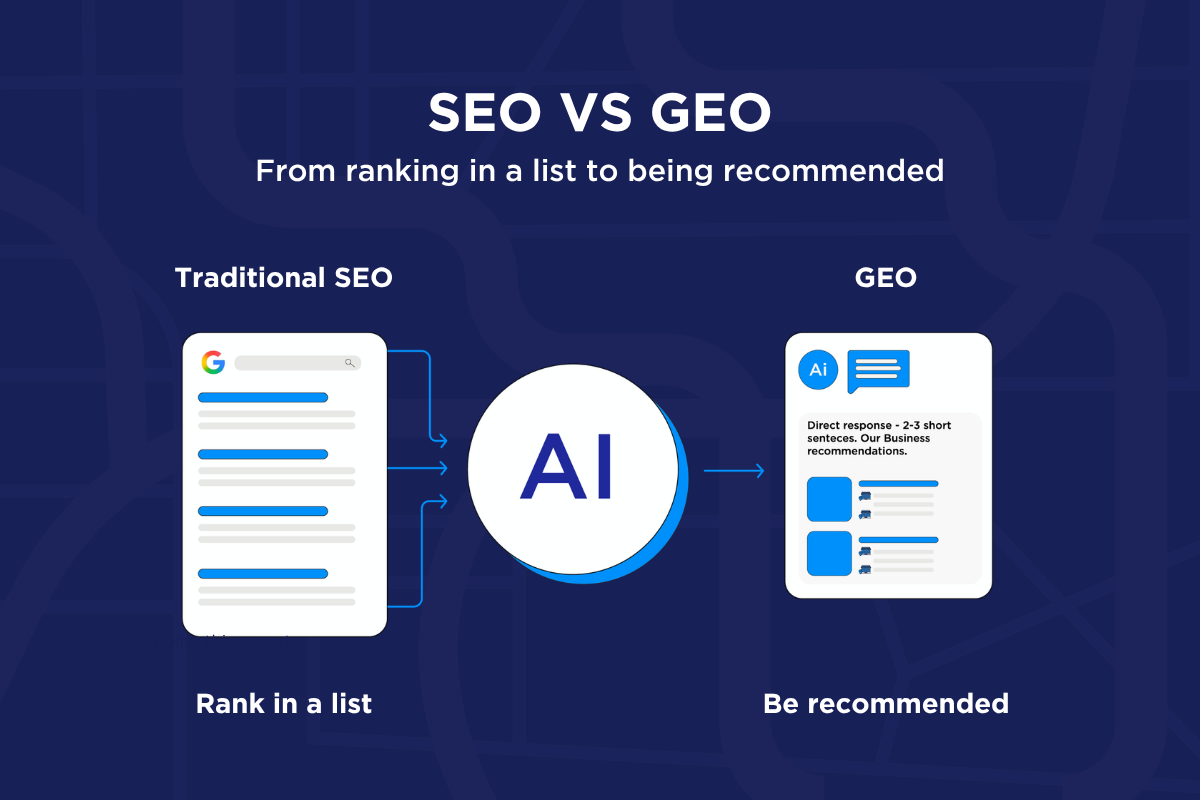
With traditional SEO, you're trying to rank in a search results list. Someone searches, sees 10+ results, and clicks one of them. Your goal is to be as high up that list as possible, as you already know.
With GEO, you're trying to be part of an answer. When someone asks ChatGPT which HVAC company to call in their city, it doesn't return a list of ten options. It names two or three businesses.
Being one of them is the goal. Being left out means that the customer may not know you exist.
Strong SEO foundations make you better positioned for GEO. They're not competing priorities, and they don't require a separate strategy. In many ways, GEO is what good Local SEO has been building toward all along.
GEO Questions Answered
What does GEO stand for, and what does it mean?
GEO stands for Generative Engine Optimization, sometimes called AEO (Answer Engine Optimization) or AIO (AI Optimization). It's the practice of making sure your business shows up when AI platforms generate answers to questions like "who's the best plumber in Chicago" or "which dentist near me is taking new patients." Traditional SEO gets you into a list of results. GEO gets you into the AI answer itself.
Does GEO replace SEO?
No, and anyone saying it does isn't looking at all the evidence. Google's search results still drive significant traffic for local businesses, and that's not changing anytime soon. GEO is an additional channel where customers are finding businesses, and one where your existing Local SEO foundations already help you compete.
Why do AI platforms recommend some businesses and not others?
It comes down to how clearly and consistently a business is represented online.
How do AI platforms choose which sources to cite?
AI platforms use different systems and data sources, but they generally favor content that is relevant, trustworthy, clearly structured, and easy to understand. Businesses that publish helpful content, maintain accurate information across the web, and build strong reputations are more likely to be surfaced in AI-generated responses.
Does my Google Business Profile matter for GEO?
Your Google Business Profile is an important source of business information and can influence how AI platforms understand and represent local businesses. A complete, accurate, and regularly updated profile gives AI platforms a clear picture of who you are and what you do. A neglected one creates gaps that other businesses fill.
How does this connect to what I'm already doing for Local SEO?
More directly than you might expect. If your Google Business Profile is accurate and active, your reviews are strong and recent, your business information is consistent everywhere, and your website clearly explains what you do and where you do it, you're already in good shape. If any of those things need work, that's where to start.
Can I track GEO performance?
Yes, although GEO measurement is still evolving. Several SEO and AI visibility platforms, including Semrush, Ahrefs, and specialized GEO tools, now offer ways to monitor how often brands appear in AI-generated responses.
Businesses can track:
- Brand mentions in AI-generated answers
- Visibility compared to competitors
- AI referral traffic
- Citations and source mentions
- Overall local search performance
However, AI-generated responses can vary by user, location, platform, and model version, which means GEO reporting is often directional rather than exact.
A free Local SEO audit helps tell you what comes up when someone searches for what you do in your area, where you're losing customers to competitors, and what needs fixing first.
It's also the best place to start when evaluating how your brand shows up in AI platforms.
Want to Improve Your Local SEO?
Schedule a Strategy Call
