

New Releases: Official Google GBP Guides
Read More Blog



Google’s New GBP Playbooks: What Multi-Location Brands Need to Do Right Now
If your local visibility has felt harder to control lately, this is one of those updates you do not want to miss.
Google quietly dropped a set of Google Business Profile playbooks that give you a clear, structured way to improve how your locations show up.
These guides were not heavily promoted, which means a lot of businesses have not touched them yet. That creates an opportunity. If you move early and apply this correctly across your locations, you can create a real advantage in both traditional search and AI-driven results.
In the newest episode of Local Search Tuesdays, Greg Gifford breaks down exactly how you can use these playbooks, and where to find them.
The GBP Playbook Google Didn’t Make a Big Deal About
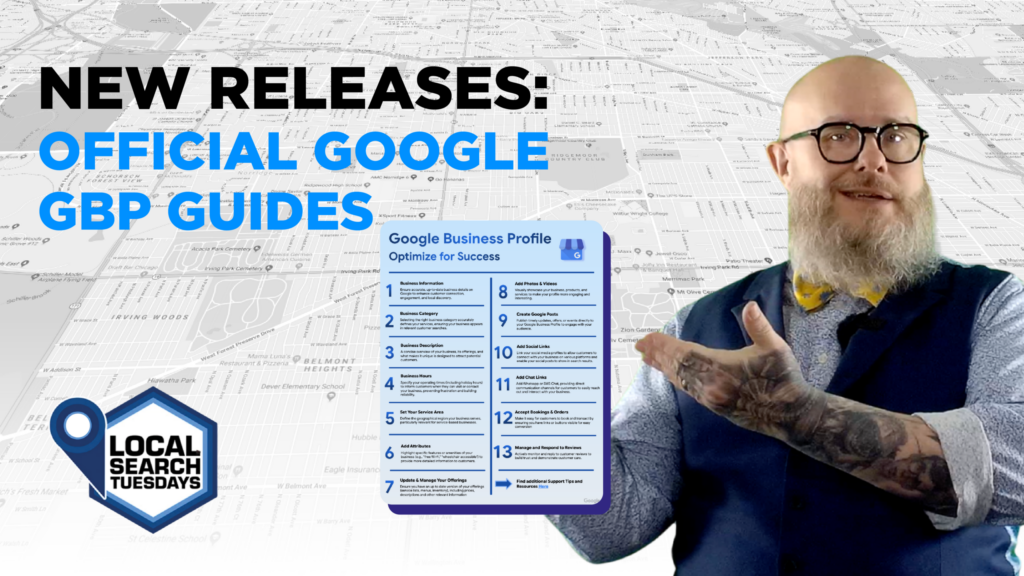
The main resource is the Google Business Profile Best Practices Playbook. You can access it here: bit.ly/gbp-guide-2026
This guide walks through the fundamentals of a properly optimized profile. That includes:
- Core business information
- Category selection
- Hours and availability
- Profile completeness
Nothing in the document talks about rankings or SEO strategy directly. What it does give you is something just as valuable. It shows you exactly how Google wants your business data structured and presented.
When your data is clean, consistent, and complete across every location, you are giving Google a reliable foundation to work with. That directly impacts how often your listings appear and how well they convert once they do.
Why This Matters More Than It Used To
There is a tendency right now to assume AI is replacing traditional local search signals. There are AI overviews that will populate when someone searches but remember AI is just finding that information somewhere. If Google’s AI model is being trained on how to find this information and Google is telling you how they want that information presented, pay attention.
AI models still need structured, trustworthy data to generate recommendations. They do not understand proximity or physical location the way Google Maps does. They rely on sources like your Google Business Profile to fill in those gaps.
Your GBP acts as a centralized data source for:
- What your business does
- Where you operate
- When you are available
- What customers think about you
That last point is especially important. AI does not have its own opinion about which business is better. It leans heavily on review data to answer those types of questions. If your profiles are incomplete, outdated, or inconsistent, you are limiting how often your business can be recommended.
A well-optimized GBP does two things at once:
- Improves your visibility in Google’s local results
- Increases your chances of being included in AI-generated recommendations
Industry-Specific Guides You Should Not Ignore
Google released guides tailored to specific business types, this was done on purpose because different industries have different needs and in some cases different rules.
Each one highlights nuances that are easy to miss if you apply a one-size-fits-all approach across locations.
Here are the additional guides:
- Service Area Businesses: bit.ly/service-gbp-guide
- Restaurants: bit.ly/restaurant-gbp-guide
- Hotels: bit.ly/hotel-gbp-guide
- Tours and Attractions: bit.ly/tours-gbp-guide
These are worth your time, especially if your business model does not fit the standard storefront setup.
For example, service area businesses operate very differently from brick-and-mortar locations. The way you define your service area, categories, and availability has a direct impact on how you show up.
Restaurants and hotels have their own complexities around menus, amenities, and booking integrations. Those details influence both visibility and conversion.
If you are managing multiple verticals under one brand, this becomes even more critical. You cannot treat every location the same and expect consistent performance.
Where Most Multi-Location Teams Get This Wrong
Most brands assume their GBP setup is “good enough” because the profiles exist and are live, but existing and being optimized are two very different things.
The gaps we see most often are not dramatic. Inconsistent categories across locations, missing or incorrect hours, incomplete services or attributes, a review presence that is either weak or completely unmanaged, profiles that were set up once and never touched again. None of these feel urgent on their own. But at scale, they compound quietly into serious performance drag.
The playbooks exist to fix that. They give you a repeatable way to standardize and tighten these issues across your entire footprint, not as a one-time audit, but as an ongoing foundation.
How to Apply This Across Multiple Locations
Reading the guides is the easy part. Execution is where most teams struggle.
Here is a practical way to approach it:
1. Audit Your Current Profiles
Start by comparing your existing listings against the general playbook.
Look for gaps in:
- Business information
- Categories
- Hours
- Completeness
Do not assume anything is correct. Verify it.
2. Align on a Standard Structure
Create a clear internal standard for how profiles should be set up.
That includes:
- Primary and secondary categories
- Naming conventions
- Service and product listings
- Attributes and features
Consistency across locations is what drives scalable results.
3. Layer in Industry-Specific Guidance
Use the vertical-specific guides to refine your approach.
This is where you pick up the details that differentiate high-performing profiles from average ones.
4. Build a Review Strategy
Reviews are not just a reputation play anymore. They are a visibility driver.
Focus on:
- Increasing review volume
- Improving review quality
- Responding consistently
This feeds both Google and AI systems with better signals about your business.
5. Create an Ongoing Maintenance Process
GBP is not a one-time setup.
You need a system for:
- Updating hours and information
- Adding new content
- Monitoring performance
- Catching inconsistencies
The brands that win here treat GBP like an active marketing channel, not a static listing.
Why This Also Helps You Manage Vendors Better
If you’re working with an SEO partner, these guides give you something concrete to point to.
No more vague performance talks. You’ll know exactly what Google considers best practice, which means you can ask sharper questions, catch gaps faster, and hold your partner to a consistent standard across every location.
The Bigger Picture
Local search is evolving with new AI overviews, and the technology we are using is advancing rapidly. That means we must start adapting now.
Your visibility is now influenced by:
- Google Business Profile optimization
- Review signals
- Website quality
- Data consistency across platforms
- AI interpretation of all of the above
These playbooks sit right at the center of that ecosystem.
For brands, getting the foundation right is what allows everything else to scale.
Key Takeaways
- Google released new GBP playbooks that outline how to properly structure and optimize your profiles
- The general guide applies to every business, while vertical-specific guides highlight important nuances
- GBP is still a critical data source for both Google search and AI-driven recommendations
- Review data plays a major role in how your business is evaluated and recommended
- Most multi-location brands have inconsistencies that limit performance across their listings
- Applying these guides at scale can improve both visibility and conversion
- The playbooks also give you a clear standard to hold internal teams or vendors accountable
Final Thoughts
This is one of those updates that looks simple on the surface but has real impact if you execute it well.
Most businesses will ignore it or only partially apply it. That creates space for you to get ahead.
Clean up your profiles. Standardize your approach. Use the guides as a framework, not a checklist you rush through once.
That is how you turn something basic into a competitive advantage.
VIDEO TRANSCRIPT
Welcome back to another episode of Local Search Tuesdays. In this week’s episode, I’m sharing a few new guides that will literally change your marketing game. Google has just released several PDF playbooks for Google Business Profiles!
Lisa Landsman at Google just released a treasure trove of information to help businesses get found by more customers. You probably haven’t heard about these guides, since they weren’t released with much fanfare, but they’re ridiculously awesome.
The primary guide you need to check out is the general Google Business Profile Best Practices Playbook – the GBPBP. You can download it at bit.ly/gbp-guide-2026. The easy to read guide walks you through how to properly optimize your GBP. It covers top line business info, category selection, hours, and so much more.
There’s nothing there about SEO or the result of following these best practices, but it’s a thorough guide for really squeezing maximum value out of your GBP.
And Lisa and her team went even further… they released several industry-specific guides, helping to point out major differences between verticals. If you’re a service business without a brick-and-mortar location, you need to check out the Service Area Business guide at bit.ly/service-gbp-guide.
Restaurants also got a specific guide. You can check that one out at bit.ly/restaurant-gbp-guide. Theres also a guide for hotels at bit.ly/hotel-gbp-guide. The final guide is for tours and attractions, and you can see that one at bit.ly/tours-gbp-guide.
Your Google Business Profile continues to be vital, even with the rising use of AI search. AI models don’t understand location or proximity, so your GBP provides crucial information to help with recommendations for nearby businesses. More importantly, your GBP is a direct feed of unique, business-specific information that AI models love. In one location, the model can learn a lot about your business and what you offer.
Another key element is customer reviews, which live on your GBP. AI models have no concept of which business is best or which business is better-liked by customers, so they rely on review data to answer those types of queries. A better-optimized GBP means the models know more about you and what customers think about you, which makes it more likely for your business to be included in any recommendations.
Even more importantly, your GBP is the keystone for success in local Google search results. A properly optimized profile shows up more often in search results – and it converts better too. And since a huge number of locally-oriented AI searches rely on grounding, that means better visibility in Google equates to better visibility in AI search results.
These guides are awesome help if you handle SEO yourself, but they can be helpful if you work with a vendor partner too. Now you’ll have a handy reference guide for best practices, so you can hold your vendor partner accountable.
Here are the links again: Make sure you check out that top GBP guide, since it applies to any business type. If any of the other four apply to you, check the appropriate one out too. You’ll have a clear path forward to help you show up more often and win more customers in 2026 and beyond.
That’s all the time we have left for today’s episode, so you know what that means. Put your hand on the screen right here: We totally just high-fived ‘cause you learned something awesome. Thanks for watching, and we’ll see you again next time for another episode of Local Search Tuesdays.
———————–
General: bit.ly/gbp-guide-2026
Service: bit.ly/service-gbp-guide
Restaurants: bit.ly/restaurant-gbp-guide
Hotels: bit.ly/hotel-gbp-guide
Tours/attractions: bit.ly/tours-gbp-guide


Ready to Grow
Your Local Business?
Local customers are searching for your services right now. We help businesses show up first through proven local marketing strategies. Our team creates customized plans that fit your budget and goals. We start with a comprehensive analysis
Schedule a Strategy Call